

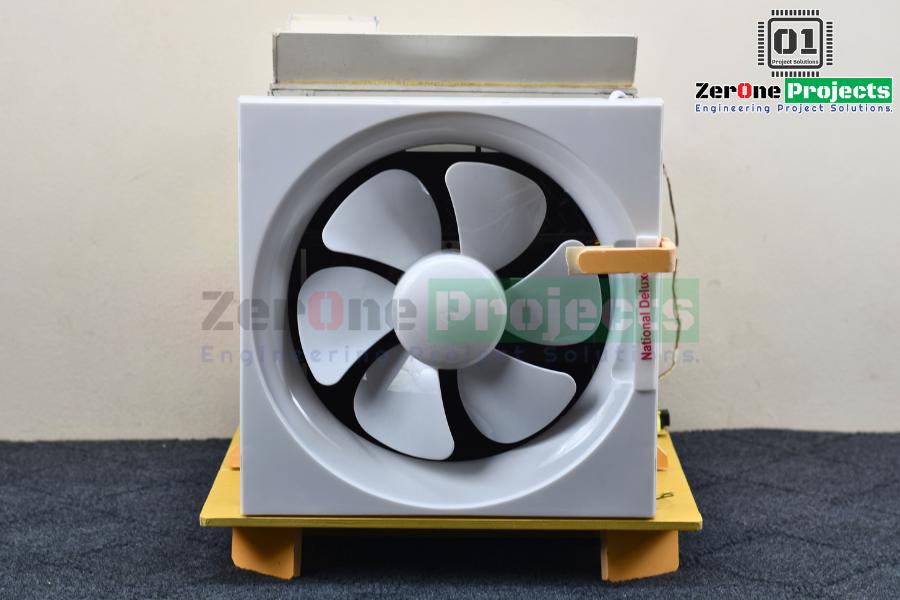
Solar Powered Evaporative Cooling System and Food Storage with Exhaust Mechanism
Project Fee:Negotiable
Project Discount:0
Project Duration:7 Days
Solar Powered Evaporative Cooling System and Food Storage with Exhaust Mechanism
The Solar-Powered Evaporative Cooling System and Food Storage with Exhaust Mechanism is designed to keep stored food cooler and improve air circulation using solar energy. The system uses evaporative cooling to reduce the storage temperature, while an exhaust fan removes excess warm and humid air. It aims to reduce food spoilage, minimize electricity consumption, and support sustainable food preservation.
Maintain a cooler food storage environment.
Reduce food spoilage caused by excessive heat.
Use solar energy to operate the system.
Improve airflow through an exhaust mechanism.
Monitor temperature and humidity.
Promote energy-efficient food storage.
Install a solar panel to generate electrical energy.
Store energy in a rechargeable battery.
Construct an insulated storage chamber with a water-based evaporative cooling pad.
Use temperature and humidity sensors to monitor storage conditions.
Operate a fan to draw air through the moist cooling pad.
Use an exhaust fan to remove warm, humid air when required.
Display environmental readings through an LCD or IoT monitoring system.
Solar Panel
Rechargeable Battery
Solar Charge Controller
DC Cooling Fan
Exhaust Fan
Evaporative Cooling Pad
Water Reservoir
Water Pump
DHT22 Temperature and Humidity Sensor
NodeMCU ESP8266
Relay Module
LCD Display
Insulated Storage Chamber
The solar panel generates electricity to power the cooling and ventilation components.
Water is supplied to the evaporative cooling pad to keep it moist.
Air passing through the pad loses heat as some water evaporates, lowering the air temperature.
The cooled air circulates inside the food storage chamber.
Temperature and humidity sensors monitor the storage environment.
When ventilation is needed, the exhaust fan removes warm or humid air.
The controller monitors the sensor readings and manages the fans and pump according to preset conditions.
Solar-powered operation
Reduced cooling energy costs
Improved air circulation
Lower storage temperature
Potential reduction in food spoilage
Environmentally friendly design
The Solar-Powered Evaporative Cooling System and Food Storage with Exhaust Mechanism combines renewable energy, evaporative cooling, and controlled ventilation to improve food storage conditions. It offers a low-energy approach that may help extend the freshness of suitable fruits and vegetables. Its effectiveness depends on ambient humidity, airflow, insulation, and the type of food stored. Temperature and humidity must be monitored carefully, as evaporative cooling alone may not provide the low temperatures required for perishable foods such as meat and dairy products.
 ০১৬৭৬-৯৯৮০৯৯, ০১৭১৪-৮০৮৪০২
 Office :
 e-mail: projects.zeronebd@gmail.com

Copyright ©2023 ZerOne IT Limited. All Rights Reserved.