
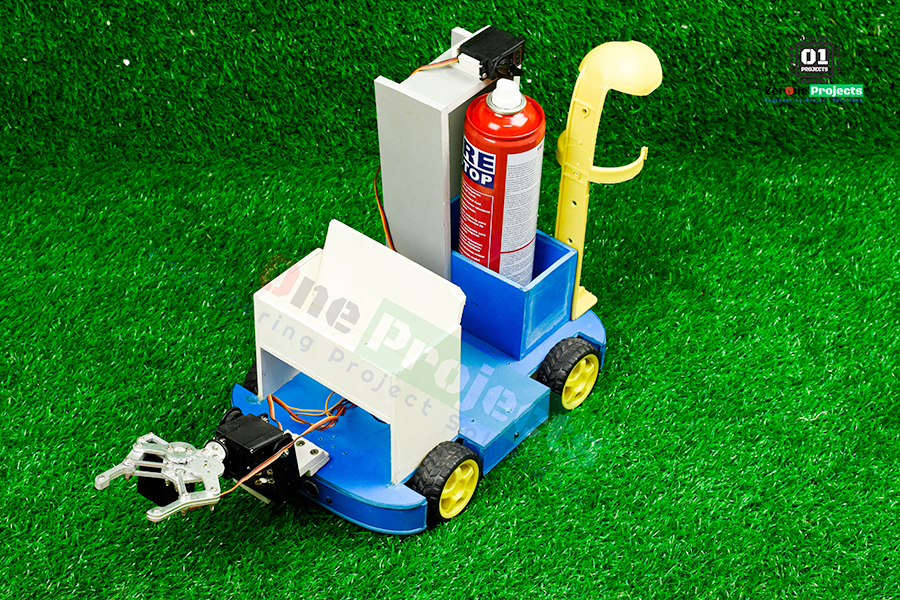

Fire Fighter Robot with Fire extinguisher System.
Project Fee:Negotiable
Project Discount:0
Project Duration:One Month
A Fire Fighter Robot with a Fire Extinguisher System is an autonomous robot designed to detect, locate, and extinguish fires in hazardous environments, such as industrial areas, buildings at risk of fire, or disaster zones. The robot is equipped with sensors, cameras, and a fire extinguisher system that allow it to autonomously navigate through environments, detect fires, and effectively extinguish them. This system is ideal for situations where human intervention is too risky or impractical, enabling efficient firefighting operations. The robot can also be remotely controlled, providing flexibility in situations where human intervention might not be possible or safe.
The Fire Fighter Robot operates through a combination of sensors, cameras, and an automated fire extinguishing system. It is first deployed into an area, where it uses thermal sensors or infrared cameras to detect the presence of fire or high temperatures. Once the fire is detected, the robot autonomously navigates towards the fire using its wheels and motors, guided by real-time data from its sensors and cameras. Upon reaching the fire, the robot activates its fire extinguisher system—typically using foam, water, or CO2 to suppress the fire. Additionally, the robot transmits live data, such as video feeds and temperature readings, to a remote control center for monitoring and further instructions. The robot is capable of adjusting its firefighting tactics based on sensor feedback, allowing it to tackle fires more efficiently.
Safety: Reduces the risk to human firefighters by allowing them to operate in hazardous environments remotely.
Autonomous Operation: The robot can detect and extinguish fires without human intervention, speeding up response time.
Real-Time Monitoring: The robot sends live data, including thermal images and video feeds, to a remote control center, providing situational awareness.
Efficiency: Ideal for environments where traditional firefighting methods are limited, such as in confined spaces or areas with toxic fumes.
Cost-Effective: Though it requires an initial investment, using robots for firefighting can reduce long-term costs and risks associated with human firefighting.
Flexibility: Can operate in areas where it’s difficult or impossible for human firefighters to reach safely.
Thermal/Infrared Sensors
Cameras (HD/Infrared)
Fire Extinguisher System (Water, Foam, CO2)
Microcontroller/Processor (e.g., Arduino, Raspberry Pi)
Motors and Wheels
Gas/Smoke Sensors
Wireless Communication System (Wi-Fi, RF)
Battery Pack/Power Supply
Chassis/Body Frame
 ০১৬৭৬-৯৯৮০৯৯, ০১৭১৪-৮০৮৪০২
 Office :
 e-mail: projects.zeronebd@gmail.com
Copyright ©2023 ZerOne IT Limited. All Rights Reserved.